
Adequacy NIS 2 pack: integrated GDPR and AI Act compliance
Since January 2023, the NIS 2 directive has strengthened cybersecurity obligations in Europe. This directive, combined with the GDPR and the AI Act (gradual application from 2026), makes the regulatory burden complex. Adequacy's NIS 2 Pack meets this challenge by offering a step-by-step approach and a unique and integrated SaaS tool. This solution supports DPOs, CIOs and CISOs towards sustainable compliance by covering these three regulations, thus avoiding redundancies, reducing costs and generating automatic proof of compliance for audits.

Find out how the Adequacy NIS 2 Pack simplifies compliance through a gradual approach and a tool SaaS unique for RGPD, AI Act and NIS 2. Practical guide and concrete examples for businesses.
NIS 2, RGPD, AI Act: understanding the challenge of multi-regulatory compliance
Since January 2023, the directive NIS 2 imposes strengthened cybersecurity obligations on European companies. Associated with RGPD and at theAI Act (whose gradual application begins in 2026), the regulatory burden may seem heavy for DPO, DSI and RSSI. However, a step-by-step approach and the use of an integrated compliance tool make this process efficient and structured.
The Adequacy NIS 2 Pack is designed to support organizations towards sustainable compliance, by covering the RGPD, theAI Act and NIS 2 in a single environment.
The challenges of cybersecurity and data protection
The multiplication of regulations creates a need for coordination. Businesses need to prioritize, coordinate, and automate compliance to avoid redundancies and hidden costs.
The benefits of a structured approach for your organization
Adopt a gradual and integrated approach, such as that proposed by Adequacy, brings immediate benefits:
- Cost reduction: Avoid duplication between RGPD, NIS 2 and AI Act
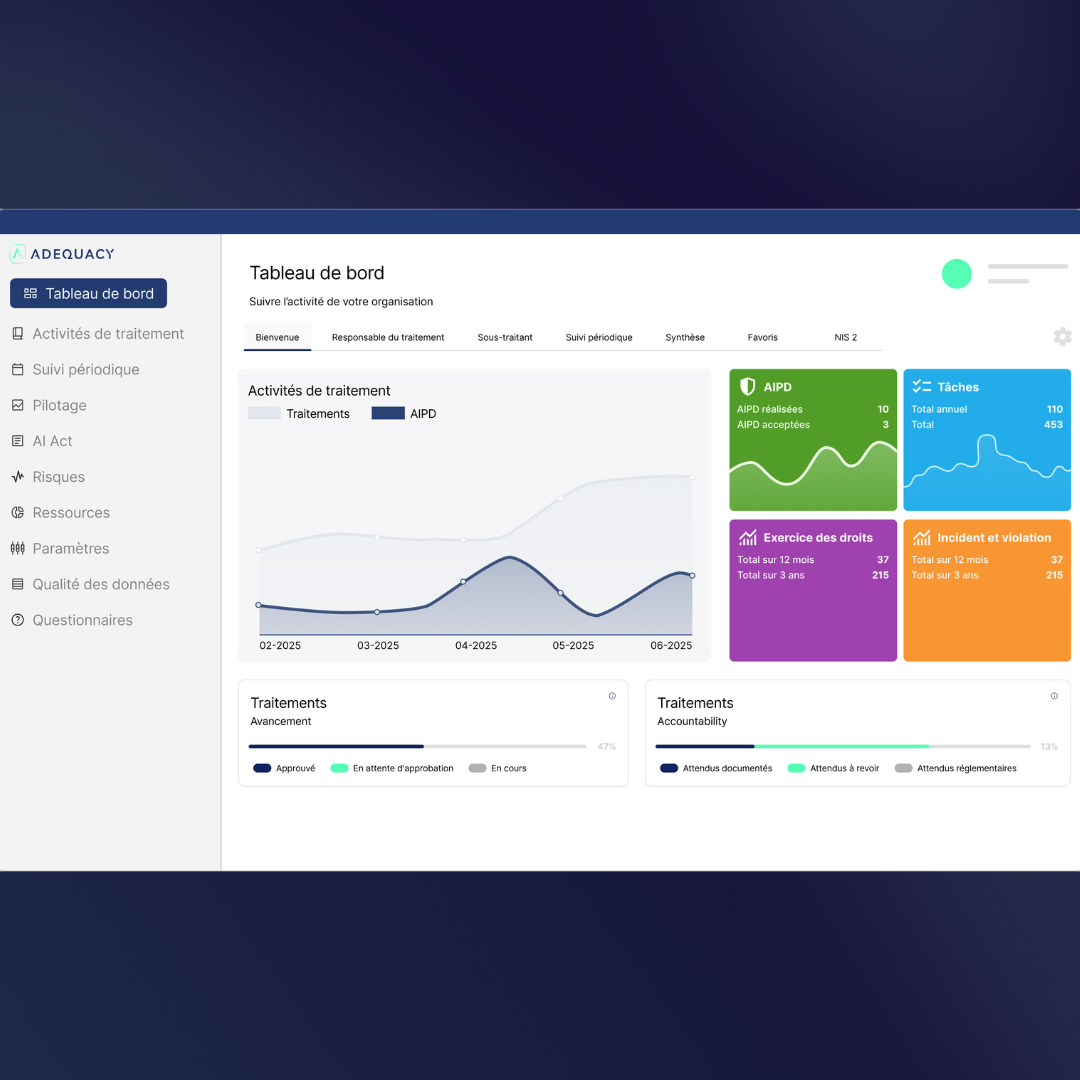
- Visibility: Centralized dashboards to track compliance progress
- Agility: Rapid adaptation to regulatory changes and new guidelines
- Proof of compliance: Automatic documentation for audits and controls NIS 2
For example, an industrial company using sensors IoT must comply with NIS 2 (cybersecurity), at RGPD (personal data of employees) and to theAI Act (if she usesAI for predictive maintenance). A step-by-step approach makes it possible to deal with each requirement logically.
The NIS 2 Adequacy pack: the all-in-one SaaS solution
The Adequacy NIS 2 Pack offers a single platform to orchestrate all of your regulatory obligations, guaranteeing a 40% reduction in time spent on compliance.
Key features for optimized risk management
Practical case: compliance of a critical organization (Health sector)
Background: A hospital, considered to be an essential entity, must comply with NIS 2 (health systems safety), at RGPD (patient data) and to theAI Act (if usingAI for diagnosis).
Approach with Adequacy:
- Step 1: Mapping — Identify patient data, critical systems, and algorithms
- Step 2: Risk Assessment — Prioritize threats (cyberattacks, data leaks, algorithmic biases)
- Step 3: Setting up controls — Encryption, DPIA, artificial intelligence records, incident response plans NIS 2
- Step 4: Training and Awareness — Train staff in best practices
- Step 5: Audit and continuous improvement — Use dashboards to track indicators
Gain: Compliance achieved in 6 months (compared to 12+ without tools), with documentation ready for audits.
The 5 key steps for successful NIS 2 compliance
For successful and sustainable compliance, the experts atAdequacy recommend following these steps:
- Identification of obligations and assets: List the applicable regulations (NIS 2, RGPD, AI Act), map data and systems
- Risk and variance assessment: Achieve a Gap analysis between the requirements and the current situation of the organization
- Implementation of compliance measures: Implement the technical and organizational controls required by NIS 2
- Training and awareness-raising: Train teams in cybersecurity issues, RGPD and AI Act
- Audit and continuous improvement: Regularly audit compliance and document evidence via the tool Adequacy
{{newsletter}}
Why choose Adequacy to manage NIS 2, the GDPR and the AI Act?
Choose Adequacymeans opting for peace of mind and efficiency:
- An all-in-one solution for RGPD, AI Act and NIS 2
- Native integration with existing systems (SIEM, ERP, cloud)
- Expert support: Access to lawyers and engineers specialized in data protection
- Customer stories: 30% reduction in compliance costs, increased peace of mind in the face of audits
Special offer: Free assessment of your level of compliance, tailor-made support for the 5 steps, unlimited access to regulatory updates.
Discover the Adequacy NIS 2 Pack
Making compliance a performance driver
With the Adequacy NIS 2 Pack, compliance is no longer a constraint, but a lever for strategic differentiation. By adopting a structured approach and an integrated tool, companies are transforming regulatory obligations (NIS 2, RGPD, AI Act) in competitive advantage: strengthened security, customer trust and operational agility.
FAQ: NIS 2 pack, GDPR and AI Act
What are the maximum penalties for non-compliance with NIS 2 and the AI Act?
Penalties for NIS 2 can reach €10 million or 2% of global turnover. Those of theAI Act are higher, up to €35 million or 7% of global turnover, and €20 million or 4% for RGPD.
How does the Adequacy tool reduce compliance costs?
The tool SaaS OfAdequacy makes it possible to avoid redundancies between requirements NIS 2, RGPD and AI Act. By integrating risk mapping and assessment in one place, it reduces compliance management time by up to 40%.
Is my business affected by NIS 2?
The directive NIS 2 applies to entities considered “essential” or “important” in critical sectors (health, energy, transport, digital, etc.). The Pack Adequacy helps you identify your obligations.
How does Adequacy manage documentation for audits?
The tool automates the generation of proof of compliance, including DPIA (for RGPD and AI Act) and records, ensuring documentation ready for audits NIS 2.
Is the AI Act already applicable?
THEAI Act has been adopted, and its application will be gradual, starting in 2026. Anticipating now via an integrated tool is essential for classifying and evaluating systems ofAI at risk.
{{newsletter}}