
GDPR compliance KPIs: the DPO reporting guide
GDPR compliance KPIs allow the DPO to demonstrate the effectiveness of their measures and engage with management using numbers rather than legal jargon. About fifteen indicators are sufficient, divided into four categories: maturity (registry completion, DPIA execution), risk and security (volume of breaches, notification time), operational and awareness (trained employees, response time for data subject requests), and efficiency (project validation time, vendor compliance). The dashboard must then be tailored to each stakeholder: a macro view for the Executive Committee, technical granularity for the CISO. An imperative driven by the accountability principle of Article 5.2 of the GDPR.

In a regulatory landscape that grows more complex every year, compliance can no longer be approached as a simple legal checklist or a burdensome administrative constraint. For Data Protection Officers (DPOs), General Counsels, and CISOs, the challenge has shifted radically: it is now about managing data as a strategic asset and managing risks in real time.
To achieve this, data protection management must align with the governance standards of other company departments. This is where key performance indicators come in. How do you structure effective reporting? Which indicators should you choose for your dashboard?
Why measure GDPR compliance?
The role of the DPO has evolved significantly. Initially perceived as an isolated technical expert, they have become a cross-functional conductor, in constant dialogue with executive management (the Comex) and operational teams (Tech, Marketing, HR).
When dealing with stakeholders focused on business and risk management, purely legal jargon quickly reaches its limits. To secure budgets, legitimize structural projects, and spread a genuine data culture, the DPO must speak the language of the business: that of numbers, trends, and compliance ROI.
Beyond internal value, measurement is a de facto obligation. The key principle of accountability, anchored at the heart of the GDPR, requires the ability to document and prove the effectiveness of implemented data protection measures at any time. Waiting for a regulatory audit to take stock is no longer an option. Having precise indicators allows you to transform a compliance initiative into a lever for customer trust and operational performance, particularly by leveraging dedicated GDPR compliance software capable of centralizing these metrics.
The 4 essential families of GDPR compliance KPIs
To build a balanced DPO report, avoid overloading your documents. Focus on about fifteen relevant GDPR compliance indicators, divided into four main strategic families.
Progress and maturity indicators
These metrics help assess the coverage level of your governance and map the progress of core initiatives.
- Completion and update rate of the record of processing activities : the percentage of processing records validated and updated in relation to the company's actual activity
- DPIA completion rate (Data Protection Impact Assessments): the number of DPIAs completed out of all projects identified as "high risk" to the rights and freedoms of individuals
Risk management and security indicators
Essential for the CISO and the General Counsel, these KPIs assess the organization's resilience to security incidents and the effectiveness of legal risk management. They are a natural extension of your compliance risk mapping.
- Volume and type of data breaches : the number of internally detected incidents, categorized by origin (human error, malicious act, technical flaw)
- Average notification time : the time elapsed between the discovery of a breach and its notification, where applicable, to the supervisory authority (CNIL) or the affected individuals
Operational and awareness indicators
Compliance is only effective when it is shared. These indicators measure team engagement and the effectiveness of operational processes.
- Rate of trained and aware employees : the percentage of employees who have completed a GDPR awareness module, with a focus on high-exposure groups (sales, marketing, and customer service teams)
- Processing time for data subject requests : the average time required to respond to requests for access, erasure, or portability
Efficiency and compliance ROI indicators
These demonstrate the added value of the compliance function and the optimization of business processes.
- Average project compliance approval time : the time required for the DPO to approve a new project or tool (measuring agility and Privacy by Design integration)
- Processor compliance rate : the percentage of business partners who have signed Data Processing Agreements (DPAs) or have been successfully audited
How to structure an effective DPO dashboard?
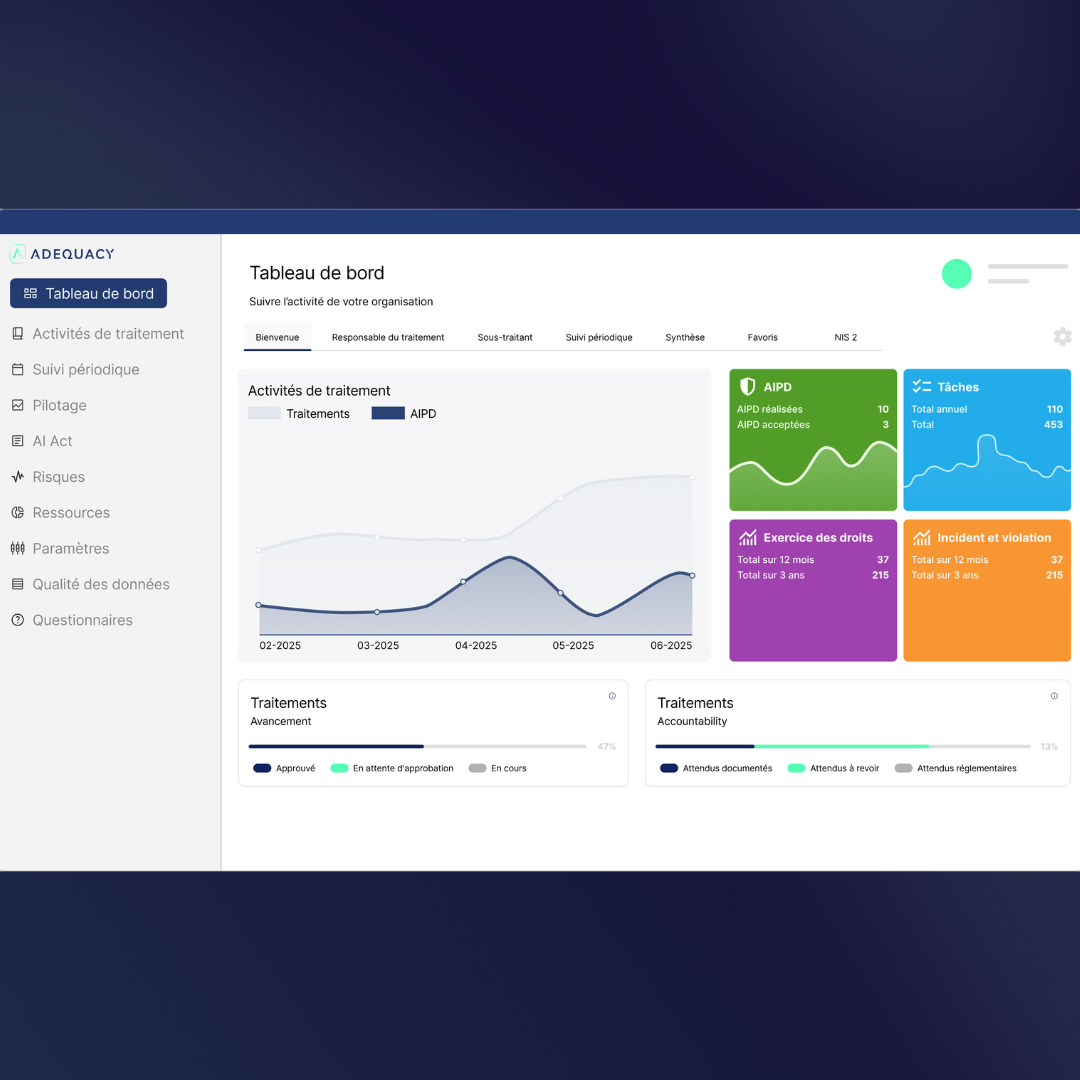
Having data is one thing; making it digestible and actionable is another. A good DPO dashboard must follow strict rules of visual clarity and be tailored to its audience.
Tailor the insights to your audience
- For the Executive Committee : get straight to the point. Present a macro view with an overall maturity score, trends in financial and reputational risk levels, and major wins (e.g., 95% of teams trained)
- For the CISO and Tech teams : focus on information systems security, cross-border data flows, and the speed of security incident response
- For your own management : use a detailed tool to track follow-ups with operational staff and projects that are behind schedule
Examples of GDPR compliance indicators by recipient
CategoryExample KPICalculation FrequencyPrimary RecipientMaturity% of processing activities documented in the registerMonthlyDPO / Legal DepartmentRisksAverage time to detect a breachQuarterlyCISO / Executive CommitteeOperationalRate of data subject access requests handled on timeMonthlyDPO / Customer ServiceAwareness% of new hires trained on GDPRAnnualHR / DPO
As technologies evolve, dashboards must also incorporate new regulatory dimensions, particularly for companies deploying artificial intelligence. It is essential to expand your skill set and learn how to manage your AI Act project to align data governance and algorithmic governance within a single reporting framework.
DPO advice: don't confuse volume with performance
Having 200 processing activities logged in your register does not mean you are compliant; it simply proves that you have documented your activities. Focus instead on the rate at which these records are regularly updated to reflect the company's operational reality.
Automating DPO reporting: from Excel spreadsheets to SaaS platforms
Many DPOs still manage their compliance using manual Excel spreadsheets. While this method may suffice when starting out, it quickly shows its limitations as an organization grows: siloed information, the risk of manual entry errors, time-consuming follow-ups with teams, and a total lack of dynamic visuals for the executive committee.
Switching to a SaaS governance platform allows you to centralize metric collection, generate automated reports, and provide tangible proof of compliance during audits. By automating low-value tasks, you free up time to focus on risk analysis and strategic consulting for business departments.
FAQ - GDPR Compliance KPIs
What are the priority GDPR KPIs to start with?
If you are just starting your reporting process, begin with three simple yet highly strategic indicators: the completion rate of the record of processing activities (for visibility), the percentage of employees trained (for corporate culture), and compliance with the legal deadline for handling data subject access requests (for exposure to complaint risks).
How many KPIs should be tracked to manage GDPR compliance?
About fifteen indicators is sufficient. Beyond that, reporting becomes unreadable and loses its decision-making power. The key is to categorize them into four complementary groups: progress and maturity indicators, risk management and security indicators, operational and awareness indicators, and finally, efficiency and compliance ROI indicators. Each group sheds light on a different dimension of your governance.
How often should compliance reporting be presented to the executive committee?
A semi-annual or annual frequency is generally ideal for the executive committee to validate major directions and budgets. However, the operational dashboard for the DPO and CISO should be updated monthly or quarterly to ensure precise risk management.
Does the GDPR legally require tracking KPIs?
No, the official text of the GDPR does not explicitly mention the term "KPI." However, Article 5(2) establishes the principle of accountability, which requires that an organization be able to demonstrate the effectiveness of its protection measures. Quantitative indicators remain the most rigorous and indisputable way to provide this proof.