
Adequacy V6.1: the GDPR software that integrates compliance with the AI Act
Adequacy V6.1 centralizes GDPR and AI Act compliance by offering DPOs, lawyers and compliance managers a modular solution to map, assess and manage their AI systems and models while automating European regulatory obligations.

Adequacy version 6.1 marks a new step in bringing organizations into compliance.
The software evolves, it evolves in particular in the optimization of some existing modules related to data protection, it is also evolving to support you in your implementation AI Act compliance.
Thanks to a self-guided, modular and innovative approach, Adequacy helps organizations map, document, and manage their AI systems while complying with European regulatory obligations.
This version is again and again aimed at DPOs, lawyers, but also compliance managers and managers who want to professionalize their approaches and secure their uses of artificial intelligence.
Thanks to a self-guided and modular approach, compliance managers, DPOs and lawyers can now structure the governance of their compliance with the AI Act, while ensuring compliance with the obligations related to their role and the level of risk of the deployed systems.
Adequacy: developments in the service of data protection
The “Registry” module benefits from several optimizations:
- Optimization of PDF/WORD editions
- New specificities in connection with the Police-Justice Directive can now be activated for our customers concerned.
- New filters are also available for the enjoyment of as many people as possible.
The “AIPD” module has also been optimized for our impact assessment enthusiasts:
- Privacy management is now available to restrict the APIs available to your various services.
- The measure selection assistant has been optimized: to save a few clicks for our DPOs who are addicted to threat scenarios.
And because we never stop you can also enjoy:
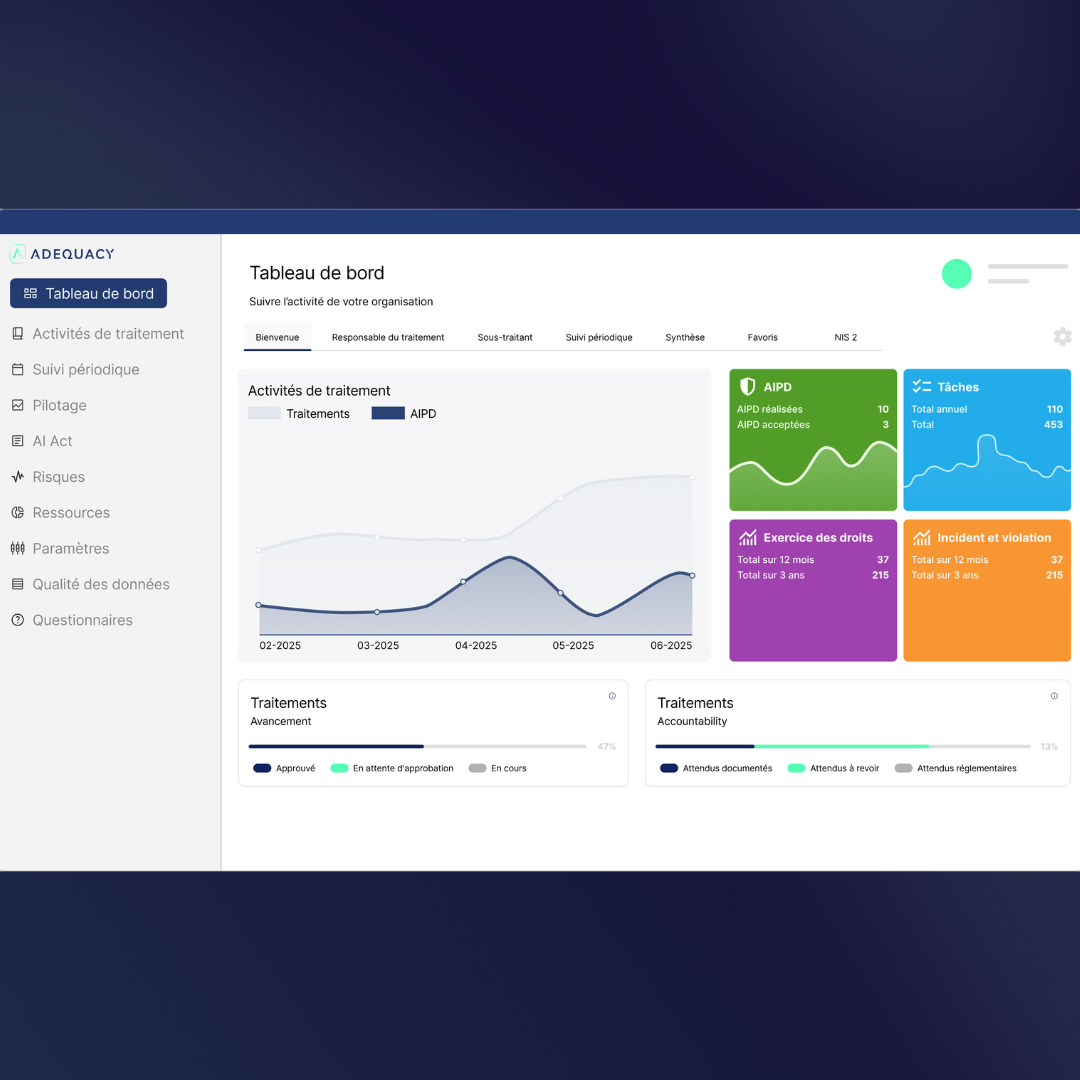
- New dashboard filters
- An input assistance device allowing you to more easily visualize the various suggestions
Adequacy AI Act: translating the AI Act into concrete actions
Faced with the arrival of the AI Act, organizations must already anticipate their regulatory obligations today.
Thanks to a self-guided and modular approach, compliance managers, DPOs and lawyers can now structure the governance of their compliance with the AI Act, while ensuring compliance with the obligations related to their role and the level of risk of the deployed systems.
Adequacy AI Act offers a operational translation of the regulatory text, allowing organizations to professionalize their compliance procedures, beyond the simple declarative framework:
- Identify and classify AI systems (SIA)
- Evaluate the risks associated with systems and models
- Manage compliance through compliance files
This approach reduces complexity and provides a significant time savings, while ensuring the necessary comprehensiveness to meet legal requirements.
Governance and mapping of AI uses
Adequacy V6.1 makes it easy to governance of their compliance with the AI Act :
- Map all AI use cases deployed in your departments and subsidiaries
- Evaluate benefits and risks of each use case
- Streamline your AI use cases thanks to a consolidated and shared view between business, IT and legal professions to limit your compliance procedures according to benefits/risks
This unified governance is the basis for sustainable and agile compliance, adapted to multi-entity environments.
SIA register and model repository
The AI Systems Registry (SIA) identifies and qualifies the artificial intelligence solutions used or developed within your organization:
- Automatically assess the risk level of each SIA
- Determine the role of your organization according to the framework defined by the AI Act (supplier, deployer, distributor...)
- Generate an exportable register and customizable (Word or PDF) for your audit and reporting needs
The Repository of AI models, a true intelligent inventory, can link each model to a system, an entity or a use case, with the possibility of:
- To assess the level of risk
- To document its technical characteristics
- Of manage compliance throughout its life cycle
Integrated compliance cases and legal assistants
Adequacy AI Act allows manage your regulatory obligations according to the level of risk through dynamic and customizable compliance files.
These files include all the formalities expected by the text:
- Technical documentation
- Instructions for use
- Risk Assessments
Each file thus becomes the central support to demonstrate your compliance and prepare for future controls.
Because artificial intelligence regulations can be complex, Adequacy AI Act provides you with integrated legal assistants to guide you step by step in your compliance procedures.
These assistants support you every step of the way:
- AI Systems Risk Level Assessment (SIA) according to their characteristics and uses
- Identifying the role of your organization (supplier, deployer, distributor...) and associated obligations
- Automatic control of obligations expected by the AI Act, depending on the role and level of risk identified
- Assessing the risk level of AI models used or trained
Didactic and personalized help to professionalize your approach and save time while securing your decisions.
Capitalize on your GDPR procedures to anticipate the AI Act
Compliance with the AI Act doesn't start from scratch. Thanks to Adequacy, you capitalize on the GDPR foundations already in place for Accelerate the compliance of your Artificial Intelligence Systems (AIS).
This approach creates a natural bridge between RGPD and AI Act, offering consistent and centralized compliance.
Adequacy, your European and international compliance partner
With this new version, Adequacy has reached a key milestone: that ofglobal compliance support, from the GDPR to the AI Act.
Professionalize your procedures, centralize your compliance data and gain confidence in the face of future European requirements.
Adequacy AI Act also makes it possible to integrate other regulations or standards relating to artificial intelligence, in particular Executive Order 14179, California SB53 (TFAIA), Chinese Generative AI Regulations, ISO 42001.