
Geolocating your children: safety or surveillance? Legal, ethical and sociological issues to know
The geolocation of children is attracting more and more parents concerned about safety, but it also raises legal and ethical risks. Between protection and surveillance, the legal framework (RGPD, CNIL) and sociological issues make it possible to understand where to put the limit to protect without locking in.
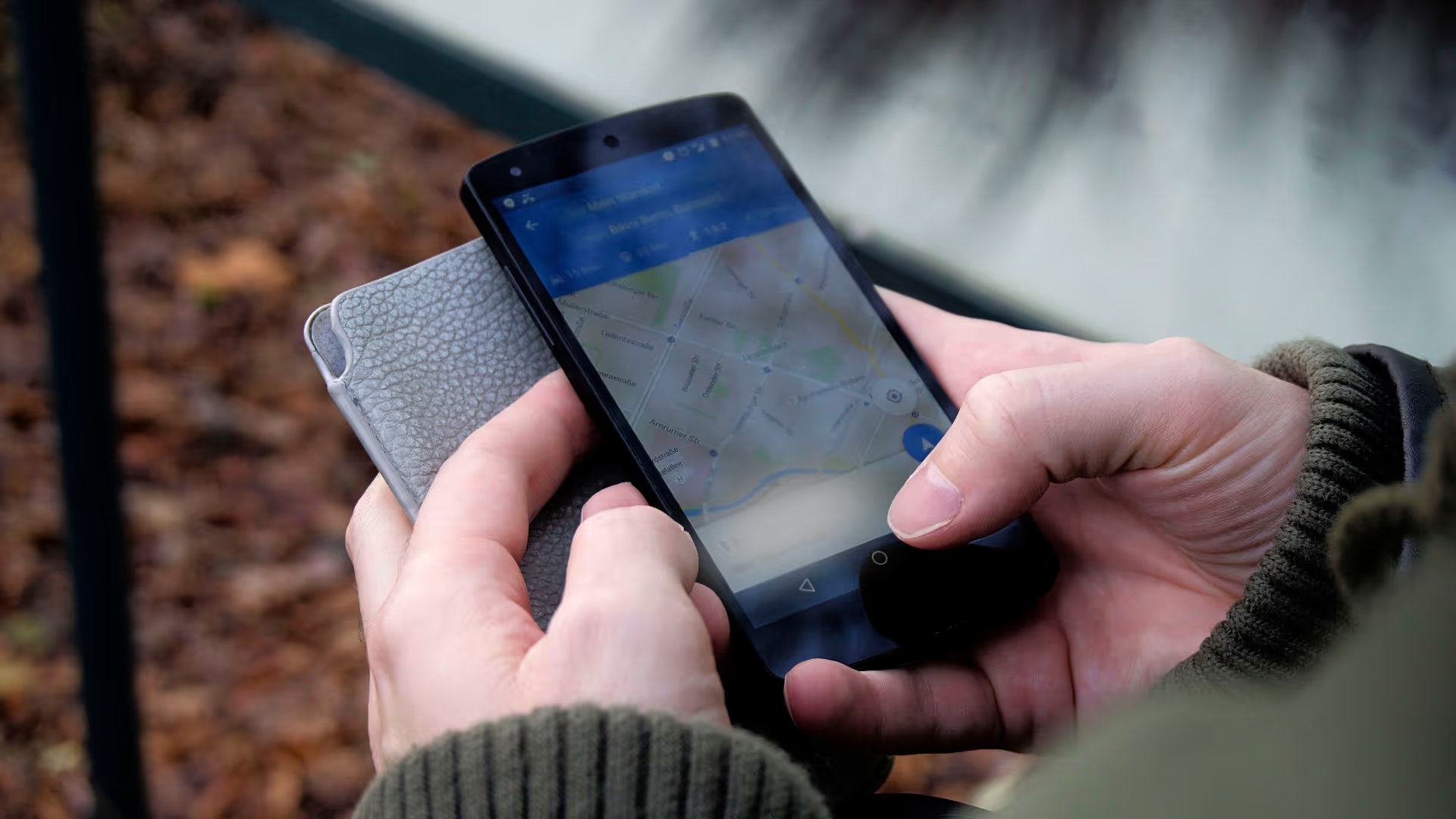
“Protect without incarcerating” could be the motto of a careful parent when dealing with new digital tools.
A changing digital and parental context
With the rise of connected objects — watches, GPS trackers, connected games and toys, smartphones — the geolocation of children has become both a temptation, a tool for worried parents, and a latent risk for children's privacy and development. The CNIL recalls the main challenges: intrusion, autonomy, trust, data security - CNIL
The legal and jurisprudential framework: what you need to know
The RGPD, the Data Protection Act, and the recommendations of the CNIL
- The CNIL recommends to seek the consent of both parents for minors under 15 when it comes to optional data processing such as geolocation - CNIL
- She also recalls that permanent geolocation is intrusive, that this function should be deactivated when it is not necessary, and that less intrusive devices should be preferred - CNIL
National and European case law
- Affair Uzun v. Germany (European Court of Human Rights, 2010): the ECHR considered that GPS surveillance, when systematic and prolonged, constitutes an interference with privacy within the meaning of Article 8 of the Convention, which must be proportionate - Senate
- CNIL decision MED-2018-043 of October 8, 2018: a company cannot keep geolocation data for 13 months for the purposes of profiling and advertising targeting, on the grounds that it was disproportionate - Legifrance
- A stop Court of Cassation, Criminal Chamber, October 22, 2013 (no. 13-81.949) : the Court considered that controlling the movements of a suspected person (via telephone geolocation) constitutes an invasion of privacy whose seriousness requires judicial review - Dalloz Étudiant
Gaps or grey areas
- In France, There is no law that formally prohibits for a parent to place a GPS tracker in the bag of their minor child. But practitioners believe that this should be based on a legitimate interest, be justified, proportionate, and as far as possible with the consent of the child - Paris Bar Lawyers +1
- In the case of separation of parents, the agreement of both is often considered necessary, especially if one of the parents objects - Paris Bar Lawyers
Concrete cases: press, testimonies, real uses
Recent testimonies in France
- After the tragedy of Louise, 11 years, found dead in Essonne, several parents testify to having installed geolocation systems on their children's phones, to reassure themselves - France 3 Regions
- Example of the mother living in Fouquebrune, who says: “As soon as they had a phone... I installed the Family Link application... to geolocate them.” - Charentelibre.fr
In the media: between alarm, trivialization and reflection
- TF1/JT report on “Child safety: geolocation to reassure parents”, which indicates that some parents practice geolocation without the child's knowledge, others believe that it is “legal, but...” . - TF1+
- Article in Charente Libre describing the growing trend among parents to use applications, watches or trackers, in the name of family safety, but warning about excessive use or without dialogue - Charentelibre.fr
Ethical, sociological and moral issues
Autonomy, trust, psychological development
- Overprotection vs learning: constant monitoring can hinder a child's ability to assess risks, to make decisions, to develop autonomy. Parent-child trust can be weakened. The CNIL underlines this - CNIL
- Effect on the relationship with privacy: does the child learn to consider privacy as normal if always followed? Risk of guilt on the part of the child (“Why don't you want me to know where you are?”) , or the feeling of being watched all the time - CNIL
Privacy, Data, Security, and Operations
- Technical risks: hacking, leaks, poor server security, inadequate use or misuse of location data - CNIL
- Retention period, purpose of processing: advertising use, profiling, or long storage without justification endanger fundamental rights. Example of the CNIL sanction for excessive conservation - Legifrance
Morality and parental responsibility
- Responsibility to choose what is necessary, proportionate, and transparent: informing children as soon as they are old enough to understand, negotiating uses, setting limits
- Duty of ethics in the digital world: parents, but also manufacturers and service providers, have a social responsibility in the design and implementation of these devices (security, data, ergonomics, information)
- Sociological meaning: this debate refers to cultural fear — fear of insecurity, fear of the unknown — but also to the transformation of parental expectations: hypervigilance, demand for control, sometimes to the detriment of the child's individual freedom
Best practices: finding a balance
Conclusion revisited: towards responsible geolocation
The geolocation of children is at the crossroads of the useful and the risky. It can be a valuable tool for security, but it becomes a problem when it becomes the rule, constant surveillance, and lack of consent.
- Legally, rules exist, but it's often practices, transparency, accountability, and moral conscience that make the difference
- On the sociological level, we perceive a tension: the balance between the desire to protect (and to reassure oneself) and the need, for the child, to be free, respected, autonomous.
Morally, the child is not an object of control: he is a subject, who deserves to be treated with trust, respect, with rights, with voice.
And let's remember: what we impose on a child, we must be able to accept for ourselves.
Would we, adults, agree to be monitored constantly, without the possibility of escaping parental, marital or professional attention?
If the answer is no, why require it from a child?
Privacy is not given, it is built — with care, balance and responsibility.