
CRM and GDPR: how to secure your customer data in the age of AI?
Making a CRM GDPR-compliant relies on three pillars: an appropriate legal basis (legitimate interest in B2B, consent in B2C), controlled retention periods, and a simple process for exercising data subject rights. Since August 2026, the AI Act has added transparency obligations for AI features integrated into CRMs.

A CRM (Customer Relationship Management) system is the tool that centralizes interactions with your prospects and customers, manages your sales funnels, and fuels your growth campaigns. It is the heart of any B2B sales strategy, but also one of the most critical risk areas regardingCRM and GDPR.
The General Data Protection Regulation (GDPR) and the European AI Act now both govern the use of these tools. CNIL audits on prospecting are on the rise, and the major obligations of the AI Act have been in effect sinceAugust 2, 2026.
How can you reconcile the performance of your Sales and Growth teams with strict compliance, without paralyzing your business? This operational guide details the method for making your CRM a compliant, high-performing, and sustainable asset.
Why is CRM and GDPR compliance a priority in 2026?
CRM and GDPR compliance is a priority because the CNIL systematically targets companies that maintain databases of inactive prospects or engage in cold emailing without following the rules. Furthermore, the AI integrated into CRMs makes them complex automated processing systems subject to the AI Act.
For a long time, CRM compliance was seen as a mere legal formality: a checkbox on a contact form or a privacy policy relegated to the footer. Those days are over.
The risk of "ghost databases"
The CNIL specifically targets companies that maintain "ghost databases" filled with prospects who have been inactive for years. A poorly managed CRM accumulates obsolete data that:
- distorts your sales performance metrics (open rates, deliverability)
- increases your exposure to financial penalties
The CRM, now an AI system
Salesforce, HubSpot, and Pipedrive are now heavily integrating artificial intelligence:
- predictive opportunity scoring
- automated email generation
- dynamic segmentation
Your CRM is no longer just an address book. Securing this data processing has become essential to earning the trust of B2B clients who are increasingly demanding regarding their data governance.
How can you make your CRM GDPR compliant?
Making a CRM GDPR compliant is based on three pillars: the legitimacy of data collection (legal basis and transparency), control over the data lifecycle (retention and deletion), and individual autonomy (exercising rights directly within the tool).
What is the legal basis for B2B and B2C prospecting?
B2B commercial prospecting is based on the company's legitimate interest (opt-out), while B2C prospecting requires the individual's prior and explicit consent (opt-in). Applying B2C rules to B2B is one of the most common mistakes.
In B2B, you can therefore prospect a professional without their prior consent if three conditions are met:
- the individual is a professional
- the message is directly related to their job function (for example, offering compliance software to a DPO, rather than sports equipment)
- the person is informed at the time of collection and has a simple, immediate way to object to the processing
On your web forms, this translates to aclear notice, separate from the general terms and conditions of sale. It must indicate how the data will be used and how to exercise the right to object.
How long should data be kept in a CRM?
According to CNIL guidelines, B2B prospect data can be kept for a maximum of 3 years after the last contact. Client data remains in the active database for the duration of the contract and is then archived for 5 years. Personal data can never be kept indefinitely "just in case."
The GDPR requires a retention period proportional to the purpose of the processing. To simplify governance, segment your records into three phases: active database, intermediate archiving, and permanent deletion.
Cleaning up your prospect database is not just a legal requirement; it is also a best practice for data hygiene. A B2B prospect who has neither opened an email nor clicked a link in 3 years is a cold lead.
Automatically purging this data allows you to:
- reduce your CRM licensing costs
- improve the deliverability of your email servers
How do you manage individual rights within your CRM?
Your CRM must be able to respond to requests for access, rectification, erasure, and objection from your prospects and customers without delay, and within a maximum ofone month. Two rights require specific configuration: objection and erasure.
The right to object (unsubscribing)
When a prospect clicks "unsubscribe," the tool should not simply delete the record. Otherwise, your growth teams risk re-importing this contact during a future acquisition campaign. The best practice is to keep them in apermanent exclusion list(internal blacklist) to block any future solicitation.
The right to erasure (right to be forgotten)
If a customer requests the deletion of their data, remove it from your active database. However, keep their invoices and contracts in asecure, separate archive space, to comply with your accounting and tax obligations.
{{newsletter}}
What is the impact of the AI Act on intelligent CRMs?
The AI Act, the European regulation on artificial intelligence, applies to companies that use AI features in their CRM (Salesforce, HubSpot, etc.). As of August 2026, these companies must meet transparency obligations toward the individuals concerned and ensure human oversight of predictive scoring.
Why is your company becoming an AI deployer?
If you use the AI features integrated into your CRM, your legal status changes under European Union law: you become anAI system deployer. The chain of responsibility is organized as follows:
- the CRM vendor is the AI provider
- your company is the deployer
- Your prospects and clients are the individuals exposed to the system—the users.
What transparency obligations apply?
Article 50 of the AI Act imposes a transparency obligation. If an AI automatically generates personalized emails for your prospects or interacts with them via a front-line chatbot, you must explicitly inform the individual that they are interacting with a machine or receiving machine-generated content.
How should you manage predictive scoring and profiling?
Algorithms that predict lead scores or customer churn probability leverage massive volumes of behavioral data. Verify with your CRM provider that these models:
- do not introduce discriminatory biases
- allow for human oversight
A significant business decision, such as refusing to enter into a contract with a company based on a predictive score, cannot rely solely on an automated decision without review by a staff member.
How can you manage your CRM compliance with Adequacy?
Managing your CRM compliance with Adequacy allows you to centralize and automate GDPR and AI Act management on a dedicated platform, rather than relying on scattered Excel files. These files make it easy to lose track and expose you to security vulnerabilities.
Adequacy supports you across three key areas:
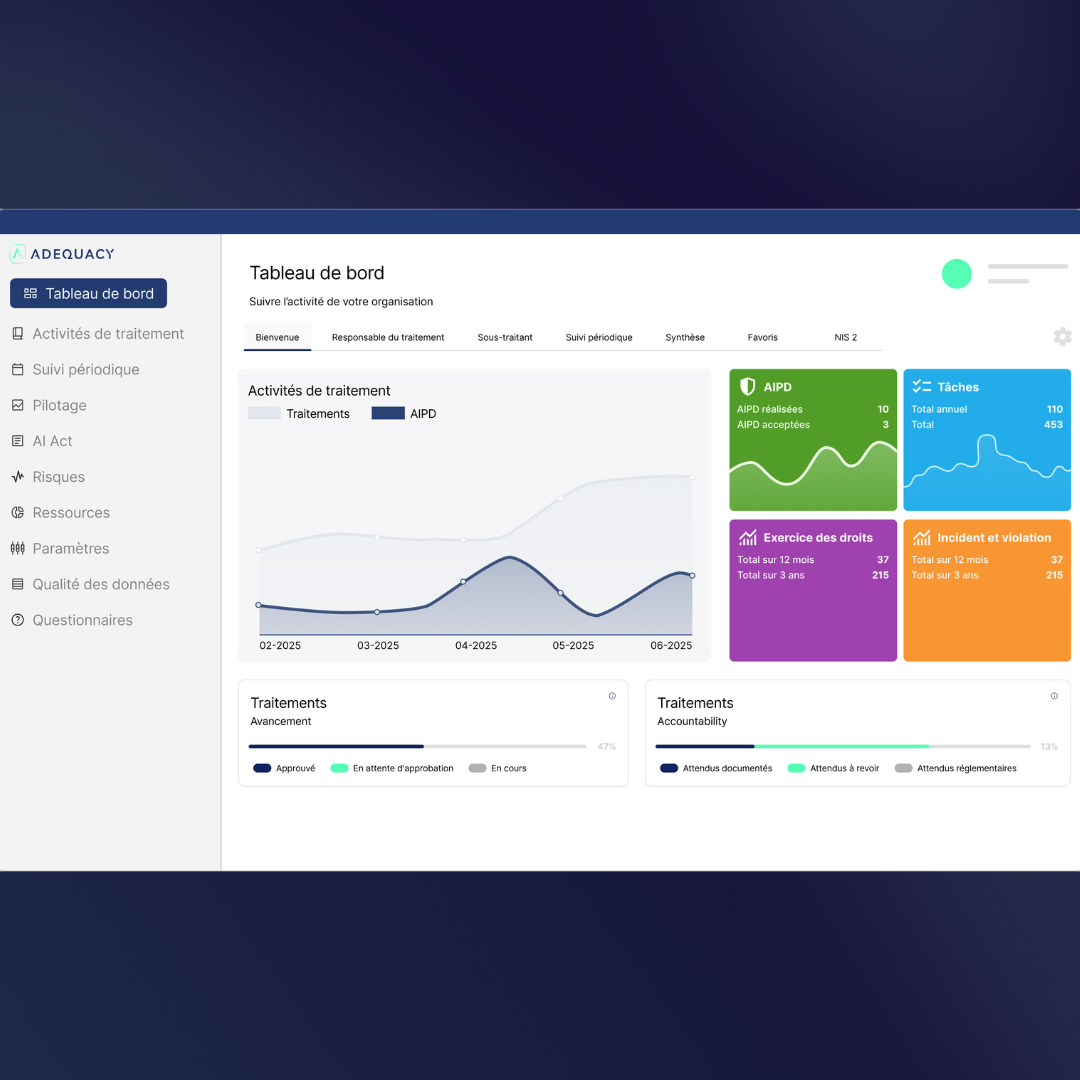
- Simplified mapping: you can document your "CRM Management" processing record in just a few clicks, identifying data flows, categories of stakeholders (Sales, Marketing, Support), and sub-processors, including your software provider.
- Lifecycle governance: you can record your data retention and deletion rules, providing immediate proof of compliance in the event of an inspection or audit.
- AI Act assessment: using our dedicated modules, you can analyze the risk level of your CRM's AI features, verify your suppliers' contractual commitments, and manage review logs for your algorithmic systems.
By combining the operational power of your CRM with the governance rigor of Adequacy, you reassure your business partners and turn compliance into a genuine selling point.
Key takeaways on CRM and GDPR
CRM and GDPR compliance rests on three pillars: a legal basis tailored to your target audience (legitimate interest for B2B, consent for B2C), adherence to retention periods (3 years for a prospect, 5 years of archiving for an inactive client), and rigorous management of opt-out and erasure requests.
Since August 2, 2026, the AI Act has also mandated transparency regarding AI-generated content and human oversight for scoring. When managed correctly, a compliant CRM is also more effective: it results in a cleaner database, better deliverability, and increased customer trust.
FAQ - CRM and GDPR
What is the maximum data retention period in a CRM?
According to CNIL guidelines, B2B prospect data must be deleted or anonymized no later than 3 years after their last contact (click, email reply, or call). Client data remains in the active database for the duration of the contract, then is archived for 5 years (commercial statute of limitations) before final destruction.
Can you perform B2B cold emailing without prior consent?
Yes, B2B cold emailing is permitted without prior consent based on legitimate interest, provided three cumulative criteria are met:
- the individual is a professional
- the message is directly related to their professional activity
- it contains a clear and functional opt-out link
Should you delete a prospect who unsubscribes from your CRM?
No, you should not simply delete their record. A deleted contact risks being re-imported during a future acquisition campaign. The best practice is to keep them on a permanent exclusion list (internal blacklist) to block any future solicitation.
How do you respond to a customer's request for data erasure?
You must erase the customer's data from your CRM's active database without delay and within a maximum of one month. However, their invoices and contracts must be kept in a separate, secure archive to comply with your accounting and tax obligations.
How does the AI Act concretely impact the use of HubSpot or Salesforce?
The AI Act imposes a transparency obligation on companies using these CRMs' AI modules as deployers. If you generate content or profile your customers using AI, you must prove that the individuals concerned are informed and document these uses in your internal governance, which Adequacy greatly simplifies.
{{newsletter}}